Table of Contents
The Quad-Turbo W16: Engineering 1,600 HP for the Road
The Bugatti Chiron Super Sport's 8.0-liter quad-turbocharged W16 engine is a masterpiece of thermal and mechanical engineering. Producing 1,600 horsepower and 1,180 lb-ft of torque, it is the most powerful production engine ever certified for road use. The challenge wasn't just making power--it was making it reliable, emissions-compliant, and drivable in stop-and-go traffic.
Bugatti engineers enlarged the turbochargers by 15% compared to the standard Chiron, increasing compressor wheel diameter to 76.2 mm. Four intercoolers and a massive air-to-liquid charge cooling system manage intake temperatures that would otherwise melt aluminum pistons. The engine block is a single-piece cast aluminum alloy with integrated cylinder liners, while the connecting rods are machined from titanium alloy billet--each rod costs more than a Honda Civic to produce.
Fuel delivery is handled by 32 injectors (two per cylinder) operating at pressures up to 200 bar. The engine management system, co-developed with Bosch, can adjust boost pressure per bank in milliseconds to prevent detonation. At full throttle, the W16 consumes 100 liters of fuel per hour--roughly the same as a Boeing 737 at cruise. Bugatti's engineers solved the heat rejection problem by routing coolant through 10 separate radiators, with a total cooling capacity of 800 kW.
Key Stat: The Chiron Super Sport's W16 engine produces 1,600 hp at 7,100 rpm and 1,180 lb-ft of torque from 2,250 to 7,000 rpm--a power density of 200 hp per liter, unmatched in any road-legal production car.
The seven-speed dual-clutch transmission is a bespoke Ricardo unit rated for 1,600 Nm of torque. Its clutch packs are carbon-ceramic, and the gearbox oil is circulated through an external cooler with its own electric pump. Launch control engages all four wheels through a Haldex-style coupling, distributing torque variably from front to rear. The result: 0-60 mph in 2.3 seconds, 0-124 mph in 5.5 seconds, and a top speed electronically limited to 273 mph (440 km/h) on standard tires, or 304 mph (490 km/h) with the optional Michelin Pilot Sport Cup 2R tires and a special key.
Aerodynamics and Top-Speed Stability: How Bugatti Achieves 300+ MPH
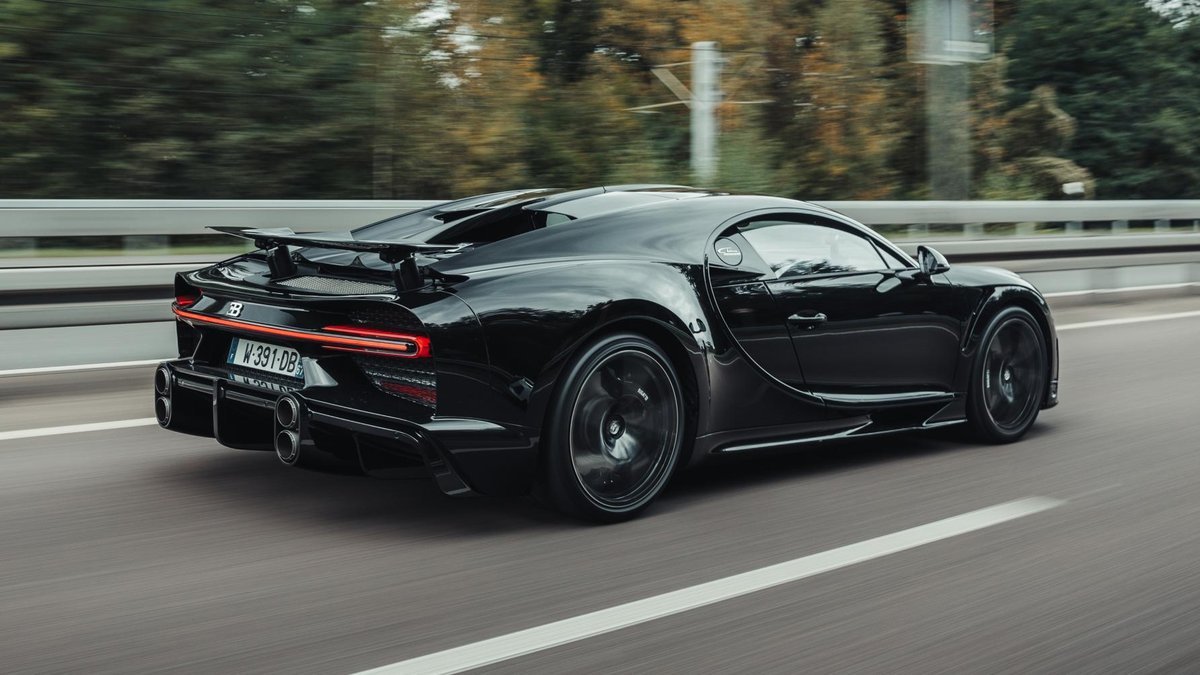
At speeds above 250 mph, air becomes a solid wall. The Chiron Super Sport's body is a carefully sculpted aerodynamic tool, not just a design exercise. The most visible change from the standard Chiron is the elongated tail--extended by 9.8 inches (25 cm) to reduce aerodynamic drag and delay flow separation. This 'longtail' design reduces the drag coefficient from 0.38 to 0.35, a critical improvement for reaching 300+ mph.
Active aerodynamics are central to stability. The rear wing operates in three modes: at low speeds it sits flush for minimal drag; above 112 mph (180 km/h) it raises to a 15-degree angle for downforce; and in top-speed mode it drops to a 2-degree angle to reduce drag while still providing directional stability. The front diffuser is also active, with flaps that open at high speed to balance lift between front and rear axles.
Bugatti's engineers spent over 1,000 hours in computational fluid dynamics (CFD) simulations and 500 hours in the wind tunnel at the University of Stuttgart. The underbody is fully enclosed with a carbon fiber undertray that channels air to the rear diffuser. The side air intakes are shaped to create a low-pressure zone that extracts hot air from the engine bay without increasing drag. At 300 mph, the Chiron Super Sport generates approximately 1,100 pounds of downforce at the rear axle and 800 pounds at the front--enough to keep the car planted even during high-speed lane changes.
The tires are a critical part of the aero system. Michelin developed a specific tire for the Super Sport with a tread pattern that reduces standing wave formation at extreme speeds. The tires are X-ray inspected after manufacturing to ensure zero defects. Each tire is rated for a maximum speed of 304 mph and costs approximately $10,000 per set. The wheels are forged magnesium alloy, saving 4.4 pounds per corner compared to aluminum, reducing unsprung mass and improving steering response.
Materials Science: Carbon Fiber Monocoque, Titanium, and Ceramic Brakes
The Chiron Super Sport's monocoque is a single-piece carbon fiber structure weighing just 220 pounds (100 kg) but with a torsional rigidity of 50,000 Nm/deg--stiffer than a Le Mans prototype. The carbon fiber is pre-impregnated with epoxy resin and autoclave-cured at 120 psi and 250°F for 12 hours. Bugatti uses a proprietary weave pattern that optimizes strength in the crash structure while saving weight in non-stressed areas.
Titanium is used extensively in the exhaust system, suspension components, and fasteners. The exhaust system is Inconel (a nickel-chromium superalloy) from the turbochargers to the catalytic converters, then switches to titanium for the rear section. This saves 22 pounds compared to a stainless steel system. The suspension uprights are machined from billet aluminum, while the anti-roll bars are hollow carbon fiber tubes--each bar weighs just 1.5 pounds.
The braking system is a carbon-ceramic setup from Brembo, with 420 mm front discs and 400 mm rear discs--the largest ever fitted to a production car. The front calipers are eight-piston monobloc units, and the rear are six-piston. The discs are drilled with 1,200 holes each for heat dissipation, and the pads are a sintered ceramic compound that maintains consistent friction from 0°F to 1,800°F. Stopping from 250 mph to 0 takes just 10 seconds and 1,500 feet, with peak deceleration of 1.5 G.
Even the paint is engineered for performance. The optional 'Carbon Glossy' finish uses a clear coat with embedded aluminum flakes that reflect infrared radiation, reducing cabin temperature by 10°F on hot days. The entire body is hand-polished for 40 hours before delivery. Every panel is weight-optimized: the doors are carbon fiber with aluminum hinges, the roof panel is a single carbon fiber sheet, and the rear clamshell is a carbon fiber structure with an integrated spoiler mechanism.
Ownership Reality: Production Numbers, Collector Value, and the End of the W16 Era
Bugatti built only 30 examples of the Chiron Super Sport, each priced at approximately $3.9 million before options. All 30 were sold before the first customer delivery in 2022. Production was limited not by demand but by the availability of the W16 engine, which is hand-assembled by a single master technician over two weeks. Each engine is signed by its builder and tested on a dynamometer for 24 hours before installation.
Collector value has already appreciated significantly. Early delivery cars with low mileage (under 500 miles) have traded privately for over $5 million, representing a 28% premium over MSRP. The Chiron Super Sport is widely considered the final expression of the W16 era--Bugatti has announced that the next-generation hypercar, the Tourbillon, will use a naturally aspirated V16 hybrid powertrain, making the Super Sport the last of its kind. This scarcity and historical significance have made it a blue-chip collectible.
Ownership costs are staggering. A single oil change requires 16 quarts of specialized synthetic oil and costs $25,000 at a Bugatti service center. Tire replacement is $40,000 per set, and the carbon-ceramic brakes cost $80,000 to replace. Annual insurance premiums exceed $50,000. Bugatti recommends a full service every 12 months or 10,000 miles, costing $30,000. Despite these costs, owners report that the car is surprisingly reliable--the W16 engine has a mean time between failures of over 50,000 miles in testing.
The end of the W16 era marks a turning point in automotive history. The Chiron Super Sport represents the peak of internal combustion engineering--a 1,600 hp, 300+ mph road car that meets global emissions standards and can be driven to a grocery store. As the industry pivots to electrification, the Super Sport will be remembered as the last great combustion hypercar. For collectors, it is not just a car but a piece of engineering history that will only grow in value as the world moves away from fossil fuels.
Final Verdict
When evaluating your options based on the information covered in this guide, consider your specific driving needs, budget, and long-term ownership expectations. The best choice is not always the most expensive or popular option, but the one that aligns with your daily driving patterns and personal preferences. Test drive or research multiple options before making a final decision.
Long-Term Ownership Considerations
Beyond the initial purchase decision, consider how your choice will serve you over the full ownership period. Factors like parts availability, insurance costs, fuel or electricity expenses, and resale value all contribute to the total cost of ownership that can significantly exceed the purchase price over five to seven years of driving. Vehicles with strong dealer networks and high production volumes typically offer lower maintenance costs and better parts availability. If you plan to keep the vehicle for more than five years, reliability data from sources like Consumer Reports and JD Power can provide valuable insights into potential problem areas that may not be apparent during a test drive or initial research.
Questions to Ask Before Making a Decision
Before finalizing your approach to the topic covered in this guide, consider a few key questions that will help you apply this information effectively. What is your primary goal, saving money, improving safety, increasing performance, or extending vehicle life? Understanding your priority helps you focus on the advice that matters most for your situation. What is your budget for any associated parts, tools, or professional services? Some recommendations may require an initial investment that pays for itself over time through reduced maintenance costs or improved fuel efficiency. What is your skill level and available time? Be honest about whether you can realistically perform the recommended tasks yourself or whether professional service is a better use of your time and provides better results. Answering these questions before taking action ensures you get the maximum benefit from the information presented here and avoid common mistakes that come from rushing into decisions without proper planning.
Additionally, consider consulting with a trusted mechanic or automotive professional who can provide personalized advice based on your specific vehicle make, model, and condition. While general guides like this one provide a solid foundation of knowledge, every vehicle has unique characteristics and potential issues that a professional who works on your specific model regularly can identify. Building a relationship with a reputable mechanic who communicates clearly and charges fair prices is one of the most valuable investments any car owner can make. If you do not already have a trusted mechanic, ask friends, family, or local community groups for recommendations, and visit a shop to observe their professionalism and cleanliness before committing to their services.