Table of Contents
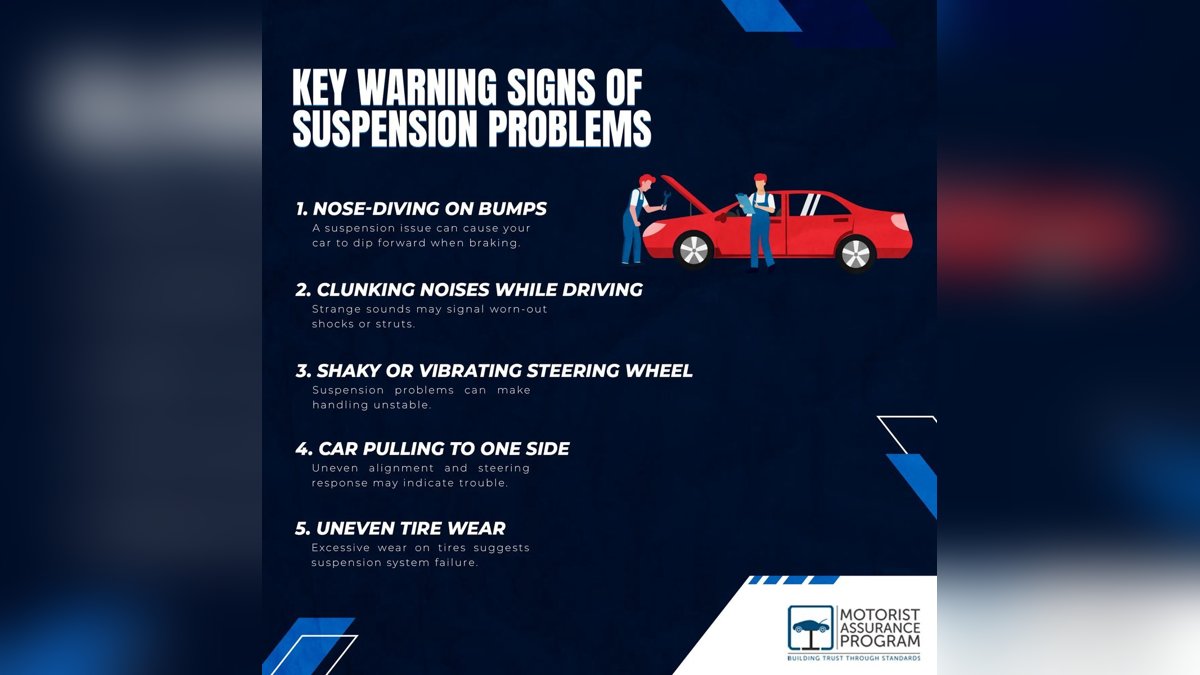
Your car's suspension system does far more than just smooth out bumps. It keeps your tires in contact with the road, maintains steering control, and ensures braking stability. When components like shocks, struts, or springs wear out, the entire vehicle becomes less safe. According to the Car Care Council, over 20% of vehicles on the road have worn shock absorbers. Catching suspension failures early can save you hundreds in additional tire and steering repairs. Here are the five most telling signs that your suspension needs attention.
1. Your Car Dives, Squats, or Sways Excessively
One of the most noticeable signs of worn shocks or struts is excessive body movement. When you brake hard, does the front of the car dip sharply? When you accelerate, does the rear squats down? If your vehicle leans aggressively during turns, the components that control weight transfer have lost their damping ability. This isn't just about comfort -- it directly affects your ability to stop and steer safely.
Test this by performing a simple bounce test. Push down firmly on one corner of the hood or trunk and release. A healthy suspension should rebound once and settle. If it bounces two or three times, the shock absorber is no longer controlling the spring movement. Driving with worn dampers increases stopping distance by up to 20%, according to testing from Monroe. Replace shocks or struts in pairs (front or rear) to maintain balanced handling.
"A vehicle with worn shocks can take up to 20% longer to stop from 60 mph -- that's an extra 30 feet or more, roughly the length of a bus." -- National Institute for Automotive Service Excellence
2. Uneven Tire Wear That's Not From Alignment Issues
Take a close look at your tires. If you see cupping, scalloping, or bald patches that appear in a repeating pattern around the tread, your suspension is likely to blame. While poor wheel alignment causes edge wear, suspension wear creates a wavy, spottiness pattern because the tire bounces as it rolls. This is often most visible on the inside or middle of the tread.
Broken or sagging springs, worn bushings, and bad strut mounts all allow the wheel to move in ways it shouldn't, scuffing the tire. If you ignore the root cause, even a brand-new tire will wear out in 10,000 miles. A suspension inspection should always follow any unusual tire wear. Alignment alone will not fix cupping -- you must replace the faulty components first. Expect to pay between $400 and $1,200 for a shock/strut replacement on a typical sedan, depending on labor and parts quality.
3. Nose Dive and Rear Squat Are Worse Than Usual
We touched on this earlier, but it deserves its own section because it's often the first symptom. When you stop at a traffic light, does the front end sink so much that you feel the car "fall" forward? That's a classic sign of worn front struts. Similarly, if the rear end sags low when you load the trunk or back seats, the springs or shocks are no longer supporting the weight properly.
Sagging also alters your headlight aim. If you find yourself getting flashed by oncoming drivers, or your low beams suddenly seem to point too high when the car is level, the rear suspension may be compressed from age. Replace both rear shocks if the vehicle sags more than one inch below normal ride height with a typical load (350 lbs). Also check that the bumper height difference from front to rear is within factory specs -- often available at a dealer or service manual.
4. Your Car Drifts or Pulls to One Side (Even After an Alignment)
A car that consistently drifts right or left can be caused by worn suspension components that allow the wheel to change its toe or camber as you drive. An alignment can correct static angles, but if a ball joint, control arm bushing, or strut mount is loose, the geometry will shift the moment you hit a bump. This makes the car feel unstable, especially on crowned roads or in crosswinds.
Lift your vehicle and grab each tire at the 3 and 9 o'clock positions and shake side to side. More than 1/4 inch of play indicates a tie rod end or rack issue -- part of the steering, but often related. Next, shake at 12 and 6. Looseness there points to a worn ball joint or wheel bearing. Any free play needs immediate professional inspection. Driving with a loose ball joint can lead to complete separation and loss of control. Replacement of a control arm with ball joint typically runs $200-$600 per side.
5. Knocking, Clunking, or Squeaking Noises Over Bumps
Pay attention to sounds when you go over speed bumps or potholes. A dull thud indicates a shock that has bottomed out because it's lost hydraulic fluid. A metallic clunk often comes from a broken sway bar link or a loose strut nut. Squeaking or groaning suggests dry ball joints or control arm bushings that have deteriorated. If you hear these noises consistently, schedule an inspection before the problem worsens.
To narrow down the noise source, drive slowly (5-10 mph) over a series of small bumps and have a friend listen from outside. Pressing down on the car body can also reveal squeaks. In many cases, a sway bar link replacement costs between $80 and $200 and is a simple fix. Don't ignore knocking -- it may mean your coil spring has broken and could puncture a tire or damage the strut assembly. A spring replacement per corner ranges from $250 to $500.
When to Seek Professional Help
If you notice any of these five warning signs, have your suspension inspected by a certified mechanic. Many shops offer free suspension checks. Expect them to inspect all components: shocks, struts, springs, control arms, ball joints, sway bar links, and bushings. A proper diagnosis takes about 30-60 minutes. Ignoring suspension issues not only compromises safety but also accelerates tire wear, alignment problems, and even brake component fatigue. Keep your ride smooth and safe by addressing these signs early.
Understanding Suspension Components
Your vehicle suspension system consists of several key components that work together to provide a smooth ride and stable handling. Struts and shocks are the primary dampening components that control spring movement, preventing your car from bouncing excessively after hitting a bump. Struts are structural components that also serve as a pivot point for the steering system, while shocks are separate units that only control dampening. Control arms connect the wheel hub to the vehicle frame through bushings and ball joints, allowing the wheel to move up and down while maintaining proper alignment. Sway bars, also called anti-roll bars, connect the left and right wheels through a torsion spring that resists body roll during cornering. When any of these components wear out, you may notice symptoms like excessive body roll in turns, a bouncy ride over bumps, uneven tire wear, or a wandering feeling on the highway where the car requires constant steering correction to stay centered in the lane.
Diagnostic Tests You Can Perform at Home
Several simple tests can help you identify suspension problems without specialized equipment. The bounce test is the most straightforward: push down firmly on each corner of your vehicle and release. If the vehicle bounces more than two and a half times before settling, the shocks or struts at that corner are likely worn and need replacement. Visual inspection of each shock or strut for fluid leaks is another reliable indicator, as oil on the outside of the unit confirms that internal seals have failed and the dampening capability is compromised. Check the condition of your tires for cupping or scalloped wear patterns, which indicate that the suspension is not keeping the tire firmly planted on the road surface. Listen for clunking noises when driving over speed bumps or uneven pavement, as these often indicate worn ball joints, bushings, or stabilizer bar links. Any of these findings warrants a professional inspection, as worn suspension components not only reduce comfort but also compromise braking stability and tire life.
Putting This Knowledge Into Practice
The techniques and information covered in this guide are most effective when applied consistently over time. Rather than trying to implement everything at once, start with one or two changes that you can maintain without feeling overwhelmed. As these become habits, gradually incorporate additional practices into your routine. The key to success with automotive maintenance and driving techniques is consistency, doing the right things regularly matters far more than doing everything perfectly once. Keep this guide bookmarked or saved for future reference, and revisit it periodically to refresh your knowledge as needed.
Questions to Ask Before Making a Decision
Before finalizing your approach to the topic covered in this guide, consider a few key questions that will help you apply this information effectively. What is your primary goal, saving money, improving safety, increasing performance, or extending vehicle life? Understanding your priority helps you focus on the advice that matters most for your situation. What is your budget for any associated parts, tools, or professional services? Some recommendations may require an initial investment that pays for itself over time through reduced maintenance costs or improved fuel efficiency. What is your skill level and available time? Be honest about whether you can realistically perform the recommended tasks yourself or whether professional service is a better use of your time and provides better results. Answering these questions before taking action ensures you get the maximum benefit from the information presented here and avoid common mistakes that come from rushing into decisions without proper planning.
Additionally, consider consulting with a trusted mechanic or automotive professional who can provide personalized advice based on your specific vehicle make, model, and condition. While general guides like this one provide a solid foundation of knowledge, every vehicle has unique characteristics and potential issues that a professional who works on your specific model regularly can identify. Building a relationship with a reputable mechanic who communicates clearly and charges fair prices is one of the most valuable investments any car owner can make. If you do not already have a trusted mechanic, ask friends, family, or local community groups for recommendations, and visit a shop to observe their professionalism and cleanliness before committing to their services.