Table of Contents
Design Philosophy: Bold Grille vs Elegant Proportions
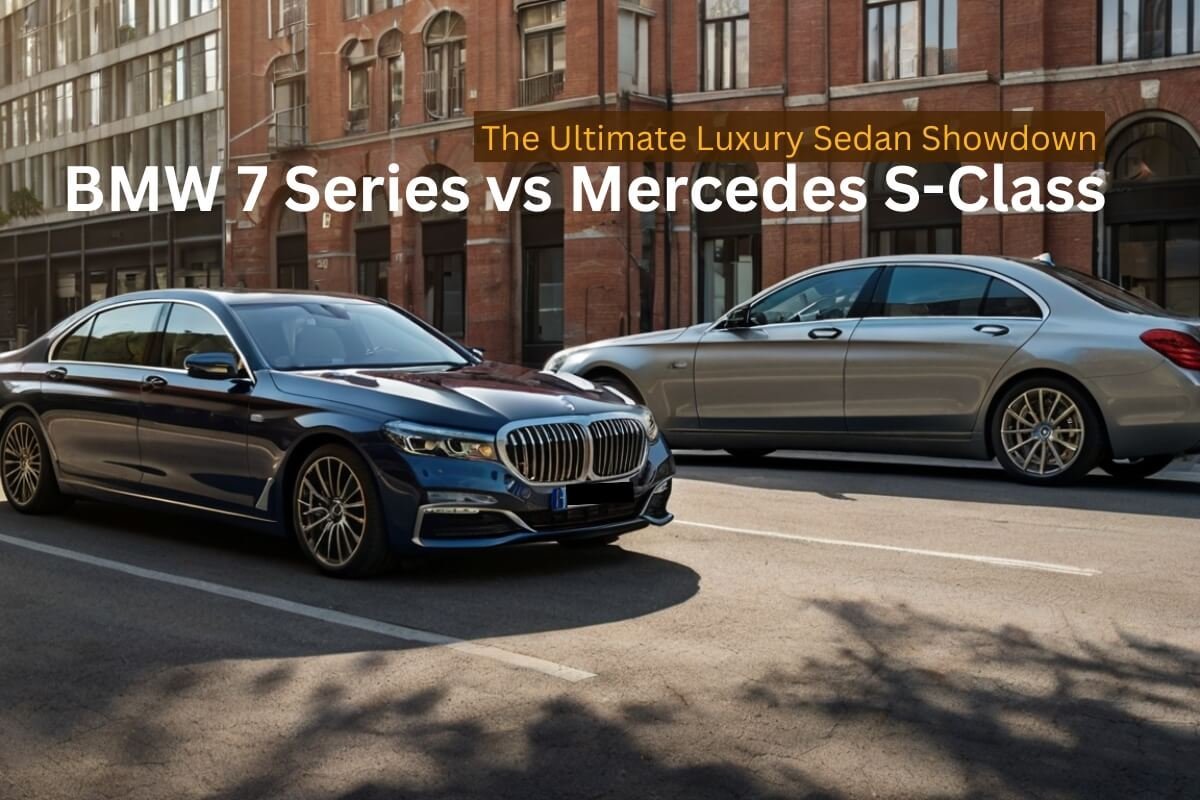
The 2026 BMW 7 Series continues its polarizing design language with an even larger kidney grille that now extends nearly the full height of the front fascia. The grille is flanked by split headlights--a slim upper daytime running light strip and a lower main beam cluster--giving the 7 Series a commanding, almost aggressive road presence. The overall shape is boxier than its predecessor, with a tall front end and a long, straight hood that emphasizes its size. In person, the 7 Series measures 212.2 inches long and 76.8 inches wide, making it slightly larger than the S-Class in every dimension.
Mercedes-Benz takes the opposite approach with the 2026 S-Class. The design is restrained, with a classic three-box silhouette, a relatively modest grille (though still large by normal standards), and smooth, uninterrupted surfaces. The S-Class measures 208.2 inches long and 76.0 inches wide, so it's visibly shorter and narrower. The Mercedes design language prioritizes elegance and timelessness over shock value. The S-Class looks expensive without trying to prove it, while the BMW demands attention. Both cars have their fans, but the S-Class is more likely to age gracefully, while the 7 Series will always be a conversation starter.
Key Stat: According to J.D. Power's 2025 APEAL Study, the Mercedes-Benz S-Class scored 882 out of 1,000 for exterior styling, while the BMW 7 Series scored 854. Owners clearly prefer the S-Class's design approach.
From a brand direction standpoint, BMW is leaning into a more expressive, technology-first identity, while Mercedes is doubling down on understated luxury. If you want to be noticed, choose the 7 Series. If you prefer subtle sophistication, the S-Class is the clear winner.
Interior Technology: Theater Screen vs MBUX Superscreen
The 2026 BMW 7 Series offers the optional 31.3-inch Theater Screen that drops down from the ceiling for rear-seat passengers. This 8K-resolution display supports Amazon Fire TV built-in, allowing streaming directly without external devices. The screen is paired with the Bowers & Wilkins Diamond Surround Sound System with 36 speakers and 1,965 watts of amplification. Front passengers get a curved 12.3-inch digital instrument cluster and a 14.9-inch central touchscreen running BMW Operating System 8.5. The Interaction Bar--a backlit, crystalline strip that runs across the dashboard and into the door panels--provides ambient lighting and touch-sensitive controls for climate and ventilation settings.
Mercedes counters with the MBUX Superscreen, a 56-inch curved glass panel that spans the entire dashboard. It integrates a 12.3-inch driver display, a 17.7-inch central OLED infotainment screen, and a 12.3-inch passenger display. The passenger screen can show video content while the car is moving, thanks to a camera that monitors the driver's eyes to ensure they aren't distracted. The S-Class also features the 3D driver display that creates a spatial depth effect for navigation and speed readouts. The ambient lighting system includes 253 LEDs that can be individually controlled, with active ambient lighting that can pulse to indicate incoming calls or navigation turns.
In real-world use, the BMW Theater Screen is a genuine differentiator for rear-seat passengers--especially for families or executives who are chauffeured. The Mercedes Superscreen is more impressive for the driver and front passenger, with a more cohesive and intuitive interface. BMW's iDrive 8.5 is quicker to learn, while Mercedes' MBUX has a steeper learning curve but offers more customization. Both systems support wireless Apple CarPlay and Android Auto, but BMW's system feels more responsive in day-to-day use.
Build quality in both cabins is exceptional. The 7 Series uses more crystalline and metallic accents, while the S-Class relies on open-pore wood, leather, and brushed metal. The S-Class seats are slightly more comfortable for long journeys, with 19-way power adjustment and a massage function that rivals a professional spa chair. The BMW seats are firmer and more supportive, better for spirited driving.
Driving Dynamics: xDrive vs Airmatic
Under the hood, the 2026 BMW 7 Series offers a range of powertrains, including the 740i with a 3.0-liter turbocharged inline-six producing 375 horsepower, the 760i xDrive with a 4.4-liter twin-turbo V8 making 536 horsepower, and the all-electric i7 xDrive60 with 536 horsepower and an estimated 300 miles of range. All gasoline models come standard with xDrive all-wheel drive, which is rear-wheel biased for a sportier feel. The 8-speed automatic transmission is smooth and quick, with paddle shifters that respond instantly.
The Mercedes-Benz S-Class offers the S 500 with a 3.0-liter turbo inline-six and 48-volt mild hybrid system producing 429 horsepower, the S 580 with a 4.0-liter twin-turbo V8 making 496 horsepower, and the EQS electric variant. All S-Class models come standard with 4MATIC all-wheel drive and the AIRMATIC air suspension with continuously adaptive damping. The S-Class also offers E-ACTIVE BODY CONTROL, which uses a stereo camera to scan the road ahead and adjust the suspension proactively for bumps and potholes.
On the road, the BMW 7 Series feels more engaging. The steering is heavier and more direct, the chassis communicates road texture better, and the rear-biased xDrive system allows for a playful rotation when you push hard in corners. The 760i xDrive accelerates from 0-60 mph in just 3.9 seconds, making it genuinely quick for a full-size luxury sedan. The ride is firm but compliant, with the optional Executive Drive Pro system offering active roll stabilization that keeps the car flat during cornering.
The Mercedes S-Class prioritizes comfort above all else. The AIRMATIC suspension absorbs bumps so effectively that you barely feel expansion joints or potholes. The E-ACTIVE BODY CONTROL system can even tilt the car into corners to reduce lateral forces on passengers. The S-Class is quieter inside, with double-pane acoustic glass and more sound deadening. The steering is lighter and less communicative, but the car feels effortlessly smooth at any speed. The S 580 hits 60 mph in 4.3 seconds, which is still quick but not as urgent as the BMW.
For drivers who enjoy the act of driving, the BMW 7 Series is the better choice. For those who want to be isolated from the road and arrive completely relaxed, the S-Class is unmatched.
Resale Value and Total Cost of Ownership
Luxury sedans depreciate faster than mainstream vehicles, but there are meaningful differences between these two flagships. According to data from Kelley Blue Book, the Mercedes-Benz S-Class retains about 42% of its original value after three years, while the BMW 7 Series retains approximately 38%. That 4-percentage-point difference translates to roughly $4,000 to $6,000 more in retained value for the S-Class on a $120,000 purchase price. The S-Class has historically been the stronger performer in the pre-owned market, partly due to its reputation for reliability and its more conservative styling that doesn't date as quickly.
Maintenance costs are substantial for both vehicles. A five-year maintenance plan for the BMW 7 Series costs approximately $6,200, covering oil changes, brake fluid, cabin filters, and spark plugs. Mercedes offers a similar prepaid maintenance plan for about $5,800. However, out-of-warranty repairs are where the difference becomes stark. The BMW's complex air suspension and electrical systems are known for higher failure rates after 60,000 miles, with common issues like the air suspension compressor failing ($2,500 repair) and the iDrive screen delamination ($1,800). The S-Class has its own expensive problems--the AIRMATIC system can leak ($3,000 repair) and the MBUX screen can develop dead pixels ($2,200).
Warranty coverage is nearly identical: both BMW and Mercedes offer a 4-year/50,000-mile basic warranty and a 4-year/50,000-mile powertrain warranty. BMW includes 3 years/36,000 miles of scheduled maintenance, while Mercedes offers 3 years/36,000 miles of prepaid maintenance as a separate purchase. Neither brand covers wear items like tires or brake pads beyond the first year.
Insurance costs are comparable, with the S-Class averaging $2,800 per year and the 7 Series averaging $2,900 per year for a driver with a clean record. Fuel economy is also similar: the 760i xDrive gets 18 mpg combined, while the S 580 gets 19 mpg combined. The inline-six models are more efficient, with the 740i achieving 24 mpg and the S 500 achieving 25 mpg.
When you factor in depreciation, maintenance, insurance, and fuel over three years, the total cost of ownership for the BMW 7 Series is approximately $68,000, while the Mercedes S-Class is about $64,000. The S-Class saves you roughly $4,000 over three years, primarily due to better resale value and slightly lower maintenance costs.
Verdict: Which One Should You Buy?
The 2026 BMW 7 Series and Mercedes-Benz S-Class are both exceptional luxury sedans, but they serve different priorities. The BMW 7 Series is the choice for driving enthusiasts who want a flagship sedan that still feels engaging behind the wheel. Its bold design, powerful engines, and rear-biased xDrive system make it the more exciting car to drive. The optional Theater Screen is a genuine differentiator for families or executives who spend significant time in the back seat.
The Mercedes-Benz S-Class remains the benchmark for comfort, refinement, and understated luxury. Its AIRMATIC suspension delivers a ride quality that no other sedan can match, and the MBUX Superscreen is the best front-seat infotainment system available. The S-Class also holds its value better and costs slightly less to own over three years.
If you're buying a car to drive yourself and you value performance and technology, get the BMW 7 Series. If you're buying a car to be driven in, or you prioritize comfort and long-term value above all else, the Mercedes-Benz S-Class is the better choice. Either way, you're getting one of the finest automobiles in the world.