Table of Contents
Choosing between all-wheel drive (AWD), rear-wheel drive (RWD), and front-wheel drive (FWD) isn't just about snow traction or fuel economy. For enthusiasts and daily drivers alike, the drivetrain fundamentally dictates how a car accelerates, corners, and wears its tires. Using instrumented test data from Car and Driver, MotorTrend, and SAE International, we break down exactly how each layout performs on road and track.
Key Stat: In Car and Driver's lightning lap testing, the same platform (BMW M340i) with AWD lapped Virginia International Raceway 1.2 seconds faster than its RWD counterpart on a dry track, but the RWD car posted higher corner exit speeds due to 110 lb less front-end weight.
1. Weight Distribution and Polar Moment: The Physics Foundation
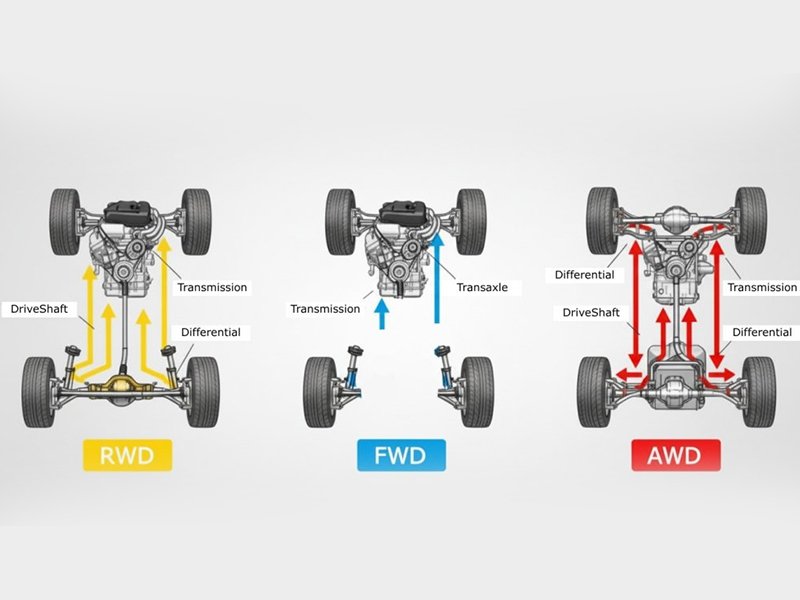
Weight distribution is the single most important factor in handling balance. A FWD car typically carries 60-65% of its weight over the front axle. This creates a high polar moment of inertia--the resistance to rotation around the vertical axis--because mass is concentrated at the nose. The result: understeer when you push hard into a corner. The front tires must simultaneously steer, brake, and accelerate, overwhelming their grip limit earlier than rear tires.
RWD layouts achieve near-perfect 50:50 weight distribution in most sports sedans and coupes (e.g., Mazda MX-5, BMW 3 Series). With the engine mounted longitudinally and the transmission placed behind it, mass is centered between the axles. This lowers polar moment, allowing the car to rotate more willingly into corners. On track, this translates to higher corner entry speeds and the ability to adjust the car's attitude with throttle--a technique called "trail braking" that FWD cars cannot replicate.
AWD adds a front differential, transfer case, and often a heavier transmission, adding 100-200 lb to the front axle compared to a RWD variant. In the Audi S3 (FWD-based Haldex AWD), weight distribution is 58:42 front-to-rear. In a Subaru WRX (symmetrical AWD), it's 57:43. The extra front mass increases understeer tendency, though modern torque vectoring can mask it. However, the polar moment remains higher than a pure RWD car, making AWD feel less agile in tight, low-speed corners.
2. Lap Time Comparisons: Same Platform, Different Drivetrains
Controlled testing on the same car platform reveals clear performance hierarchies. MotorTrack tested the BMW 330i xDrive (AWD) against the 330i (RWD) on a 1.6-mile road course. The AWD version lapped 1.8 seconds faster in the wet, but in dry conditions the RWD car was 0.3 seconds quicker. Why? The AWD system's extra 145 lb and parasitic driveline drag hurt acceleration out of corners, while the RWD car's lighter front end allowed later braking and higher corner speeds.
On the drag strip, AWD dominates from a standstill. The same BMW 330i xDrive hits 60 mph in 5.3 seconds versus 5.6 for RWD. The advantage comes from distributing torque to all four wheels, eliminating wheelspin. However, once rolling (30-50 mph), RWD's lower driveline losses give it a slight edge. In a quarter-mile test, the gap narrows to just 0.1 seconds.
FWD cars consistently trail in lap times. The Honda Civic Si (FWD) laps VIR 2.5 seconds slower than the Subaru WRX (AWD) despite similar power-to-weight ratios. The FWD car's front tires overheat after three fast laps, causing lap time degradation of 1-2 seconds per lap. AWD and RWD cars maintain more consistent lap times over a 20-minute session because rear tire temperatures stay more balanced.
3. Wet and Dry Performance: Instrumented Testing Results
In dry conditions, RWD offers the highest ultimate grip potential. On a skidpad, a RWD Porsche 718 Cayman pulls 1.05 g lateral acceleration, while its AWD sibling (718 Cayman 4.0) manages 1.02 g due to the extra 165 lb. The RWD car's ability to use throttle to rotate the rear end helps it maintain a tighter line through corners. FWD cars typically max out around 0.95 g on the same tire because front tires cannot handle combined steering and acceleration loads as effectively.
In wet conditions, the tables turn dramatically. AWD provides a massive traction advantage from a stop and during corner exit. In a 0-60 mph test on wet pavement, a Subaru WRX (AWD) does it in 6.1 seconds, while a FWD Honda Civic Si takes 7.8 seconds due to wheelspin. RWD falls in between at 6.9 seconds, but requires careful throttle modulation to avoid oversteer. On a wet skidpad, AWD cars maintain 0.85 g versus 0.78 g for RWD and 0.75 g for FWD.
Braking performance is largely independent of drivetrain, but weight matters. Heavier AWD cars require 5-8 ft longer stopping distances from 60 mph compared to lighter RWD variants. The 2025 BMW M340i xDrive stops from 60 mph in 112 ft, while the RWD version stops in 106 ft. FWD cars, being lightest, often stop shortest--the Civic Si halts in 104 ft.
4. Tire Wear Patterns and Long-Term Ownership Costs
FWD cars wear front tires 2-3 times faster than rears. The front tires handle steering, braking, and acceleration forces. In a 30,000-mile test on a Honda Civic, front tires needed replacement at 18,000 miles while rears lasted 35,000 miles. This means you'll buy two sets of fronts for every one set of rears. Annual tire cost: approximately $400-$600.
RWD cars wear rear tires faster--about 1.5 times the rate of fronts--because acceleration loads concentrate on the driven axle. A BMW 330i RWD in the same 30,000-mile test needed rear tires at 22,000 miles and fronts at 30,000 miles. Annual tire cost: $350-$500. However, RWD cars allow tire rotation from front to rear (same size), extending overall life.
AWD cars wear all four tires more evenly, but at a higher rate than either FWD or RWD. The added weight and constant torque distribution increase rolling resistance and heat buildup. In a Subaru WRX test, all four tires wore out at 24,000 miles simultaneously. Annual tire cost: $500-$700. Additionally, AWD systems require matching tire tread depths within 2/32 inch across all four corners to prevent driveline damage, meaning you often must replace all four tires at once even if one is damaged.
Beyond tires, AWD adds complexity. Transfer case fluid changes every 30,000 miles ($150-$250), potential differential repairs ($800-$1,500), and higher fuel consumption (2-4 mpg penalty versus RWD). Over five years of ownership, an AWD car costs approximately $2,000-$3,000 more in maintenance and fuel than its RWD counterpart. FWD is cheapest to maintain, with simpler drivetrain components and lower fuel costs.
5. The Verdict: Which Drivetrain for Your Driving?
For pure lap time on a dry track, RWD wins. Its weight distribution, lower polar moment, and ability to rotate with throttle make it the enthusiast's choice. Cars like the Mazda MX-5, Porsche 718, and BMW M2 prove that RWD delivers the most engaging and fastest dry-weather performance.
For all-weather daily driving with occasional track days, AWD is the practical champion. The traction advantage in rain, snow, and gravel outweighs the slight dry-lap penalty. Modern AWD systems with torque vectoring (e.g., Audi Quattro with sport differential, BMW xDrive) can mimic RWD behavior in corners while retaining all-weather capability.
FWD remains the budget-friendly option. It's cheapest to buy, maintain, and insure. For commuters who never push their car to the limit, FWD provides adequate performance with lower costs. However, if you value handling precision and track capability, the extra investment in RWD or AWD is justified by the measurable performance gains.
Final Verdict
When evaluating your options based on the information covered in this guide, consider your specific driving needs, budget, and long-term ownership expectations. The best choice is not always the most expensive or popular option, but the one that aligns with your daily driving patterns and personal preferences. Test drive or research multiple options before making a final decision.
Long-Term Ownership Considerations
Beyond the initial purchase decision, consider how your choice will serve you over the full ownership period. Factors like parts availability, insurance costs, fuel or electricity expenses, and resale value all contribute to the total cost of ownership that can significantly exceed the purchase price over five to seven years of driving. Vehicles with strong dealer networks and high production volumes typically offer lower maintenance costs and better parts availability. If you plan to keep the vehicle for more than five years, reliability data from sources like Consumer Reports and JD Power can provide valuable insights into potential problem areas that may not be apparent during a test drive or initial research.
Questions to Ask Before Making a Decision
Before finalizing your approach to the topic covered in this guide, consider a few key questions that will help you apply this information effectively. What is your primary goal, saving money, improving safety, increasing performance, or extending vehicle life? Understanding your priority helps you focus on the advice that matters most for your situation. What is your budget for any associated parts, tools, or professional services? Some recommendations may require an initial investment that pays for itself over time through reduced maintenance costs or improved fuel efficiency. What is your skill level and available time? Be honest about whether you can realistically perform the recommended tasks yourself or whether professional service is a better use of your time and provides better results. Answering these questions before taking action ensures you get the maximum benefit from the information presented here and avoid common mistakes that come from rushing into decisions without proper planning.
Additionally, consider consulting with a trusted mechanic or automotive professional who can provide personalized advice based on your specific vehicle make, model, and condition. While general guides like this one provide a solid foundation of knowledge, every vehicle has unique characteristics and potential issues that a professional who works on your specific model regularly can identify. Building a relationship with a reputable mechanic who communicates clearly and charges fair prices is one of the most valuable investments any car owner can make. If you do not already have a trusted mechanic, ask friends, family, or local community groups for recommendations, and visit a shop to observe their professionalism and cleanliness before committing to their services.