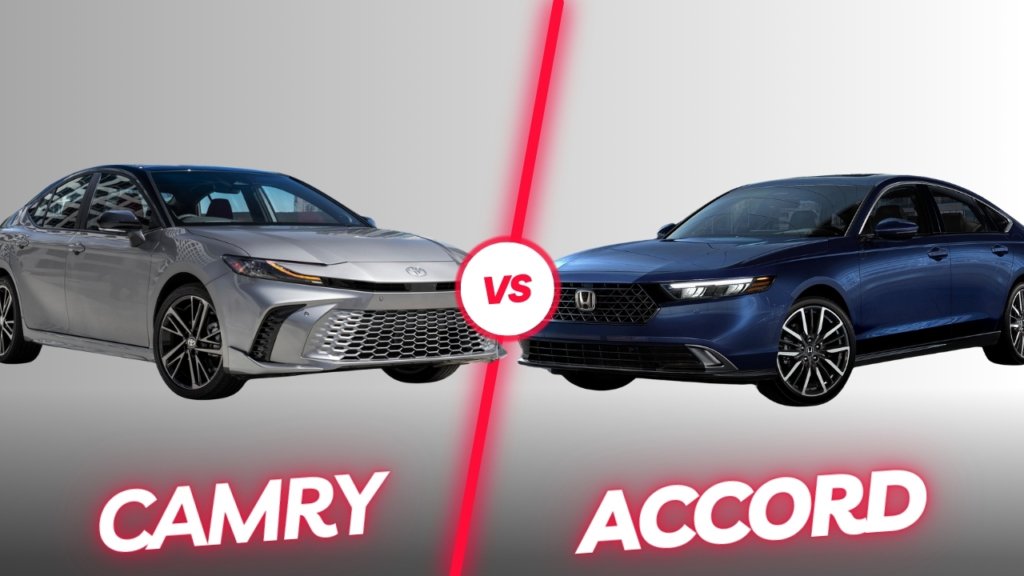
Powertrain Face-Off: Hybrid-Only Camry vs Accord's Dual-Path Strategy
The 2026 Toyota Camry makes a bold statement by dropping all purely gasoline powertrains. Every Camry now comes with Toyota's fifth-generation hybrid system, pairing a 2.5-liter four-cylinder engine with two electric motors. Front-wheel-drive models produce 225 horsepower, while all-wheel-drive variants deliver 232 horsepower. This unified approach simplifies the lineup and maximizes efficiency across the board. The Camry's hybrid system uses a continuously variable transmission (e-CVT) that delivers seamless power delivery and an EPA-estimated 51 mpg combined for FWD models.
Honda takes a different route with the 2026 Accord, offering two distinct powertrains. The base engine is a 1.5-liter turbocharged four-cylinder producing 192 horsepower and 192 lb-ft of torque, paired with a CVT. For buyers seeking better fuel economy, the Accord Hybrid combines a 2.0-liter Atkinson-cycle engine with two electric motors, producing 204 horsepower and 247 lb-ft of torque. The hybrid uses Honda's e-CVT that can operate in EV, hybrid, or engine-only modes. While the Accord Hybrid's 44 mpg combined is impressive, it trails the Camry's efficiency by a meaningful margin.
In real-world driving, the Camry's hybrid system feels more refined and linear. The transition between electric and gasoline power is nearly imperceptible, and the regenerative braking is well-calibrated. The Accord Hybrid, while smooth, occasionally lets the engine rev higher under hard acceleration, creating more noise. The turbocharged Accord offers stronger low-end torque for a sportier feel, but its 30 mpg combined is a significant compromise. For most buyers, the Camry's hybrid-only lineup delivers the best balance of performance and efficiency without forcing a choice between power and economy.
Key Stat: The 2026 Toyota Camry LE FWD achieves an EPA-estimated 51 mpg combined, saving an estimated $550 per year in fuel costs compared to the average new vehicle, according to fueleconomy.gov.
Interior Tech, Material Quality, and Rear-Seat Comfort: Which Cabin Wins?
Step inside the 2026 Camry, and you'll find a cabin that has been significantly upgraded. The dashboard features a standard 7-inch digital instrument cluster and an 8-inch infotainment touchscreen, with a 12.3-inch screen available on higher trims. Toyota's latest infotainment system supports wireless Apple CarPlay and Android Auto, and the interface is responsive with crisp graphics. Material quality has improved, with soft-touch surfaces on the dashboard and door panels, though lower trims still use some hard plastics. The front seats are supportive with 8-way power adjustment on XLE and above.
The 2026 Accord's interior continues to impress with its clean, minimalist design. A standard 10.2-inch digital instrument cluster and a 12.3-inch touchscreen come on all but the base LX trim. Honda's infotainment system is intuitive, with physical knobs for volume and tuning--a welcome touch. Material quality is slightly better than the Camry, with more soft-touch surfaces and tighter panel gaps. The Accord's front seats are among the best in class, offering excellent lumbar support and long-distance comfort. However, the lack of a wireless charging pad on lower trims is a minor annoyance.
Rear-seat comfort is a critical differentiator for family buyers. The Camry offers 38.0 inches of rear legroom, which is adequate but not class-leading. The rear seat cushion is well-shaped, but headroom is tight for taller passengers due to the sloping roofline. The Accord counters with 40.8 inches of rear legroom--best in class--and a more upright rear seat that accommodates three adults more comfortably. The Accord also offers rear USB-C ports and available rear seat heaters on Touring trim. For families who regularly carry passengers, the Accord's rear seat is the clear winner.
Real-World Fuel Economy and Annual Fuel Cost Projection
EPA estimates are useful, but real-world driving often tells a different story. In mixed driving conditions, the 2026 Camry Hybrid consistently delivers 48-52 mpg, with some owners reporting 55 mpg on highway trips. The Camry's hybrid system is optimized for stop-and-go traffic, where regenerative braking recaptures energy most effectively. Even in cold weather, the Camry maintains strong efficiency, dropping only 3-5 mpg compared to summer driving. The all-wheel-drive Camry Hybrid returns about 46 mpg combined, still excellent for an AWD sedan.
The 2026 Accord Hybrid achieves 42-45 mpg in real-world mixed driving, slightly below its EPA rating. The turbocharged 1.5-liter Accord averages 28-32 mpg, which is competitive for a non-hybrid but far behind the hybrids. In highway cruising, the Accord Hybrid can match the Camry, but in city driving, the Camry's advantage grows. The Accord's hybrid system is less efficient in stop-and-go traffic because it relies more on the gasoline engine at low speeds.
Let's project annual fuel costs based on 15,000 miles driven per year, using a national average gas price of $3.50 per gallon. The Camry Hybrid FWD (51 mpg) consumes 294 gallons annually, costing $1,029. The Accord Hybrid (44 mpg) uses 341 gallons, costing $1,194--a difference of $165 per year. The turbo Accord (30 mpg) burns 500 gallons, costing $1,750 annually. Over five years, the Camry Hybrid saves $825 compared to the Accord Hybrid and $3,605 compared to the turbo Accord. These savings add up, especially for high-mileage drivers.
Resale Value Analysis: 3-Year and 5-Year Depreciation Projections
Resale value is a critical factor for total cost of ownership. Historically, both Toyota and Honda hold their value exceptionally well, but the 2026 models show some divergence. According to industry data from Kelley Blue Book and J.D. Power, the 2026 Toyota Camry Hybrid is projected to retain 62% of its original MSRP after three years and 48% after five years. The Camry's reputation for reliability and the hybrid-only lineup's fuel savings appeal to used-car buyers, supporting strong residual values.
The 2026 Honda Accord Hybrid is expected to retain 60% after three years and 46% after five years, slightly behind the Camry. The turbocharged Accord is projected at 55% after three years and 42% after five years, reflecting lower demand for non-hybrid sedans in the used market. The Accord's slightly lower resale value is partly due to higher initial incentives and a perception that Honda's hybrid system is less proven than Toyota's decades-old hybrid technology.
Depreciation dollars tell the story. A $33,000 Camry Hybrid LE loses about $12,540 in three years and $17,160 in five years. A $33,000 Accord Hybrid EX-L loses $13,200 in three years and $17,820 in five years--a $660 difference at five years. The turbo Accord Sport at $31,000 loses $13,950 in three years and $17,980 in five years. While the differences aren't massive, the Camry's edge in resale value combined with lower fuel costs makes it the more economical choice over a five-year ownership period. For buyers who keep cars longer, the Camry's advantage grows.