Choosing the right engine type is one of the most consequential decisions a car enthusiast or daily driver can make. The debate between turbocharger, supercharger, and naturally aspirated engines isn't just about peak horsepower numbers--it's about how the car feels when you press the throttle, how much maintenance you'll face over 100,000 miles, and whether the power delivery matches your driving style. This technical buyer's guide breaks down each system's mechanics, real-world driving characteristics, long-term costs, and the best vehicles at three key price points: $30,000, $50,000, and $80,000.
Key Stat: According to a 2025 study by the Automotive Research Association, forced-induction engines (turbo and supercharged) now account for 68% of new car sales in the U.S., but naturally aspirated engines still hold a 42% reliability advantage over 100,000 miles in terms of major repair frequency.
1. Turbocharger: The Efficiency Powerhouse with Lag
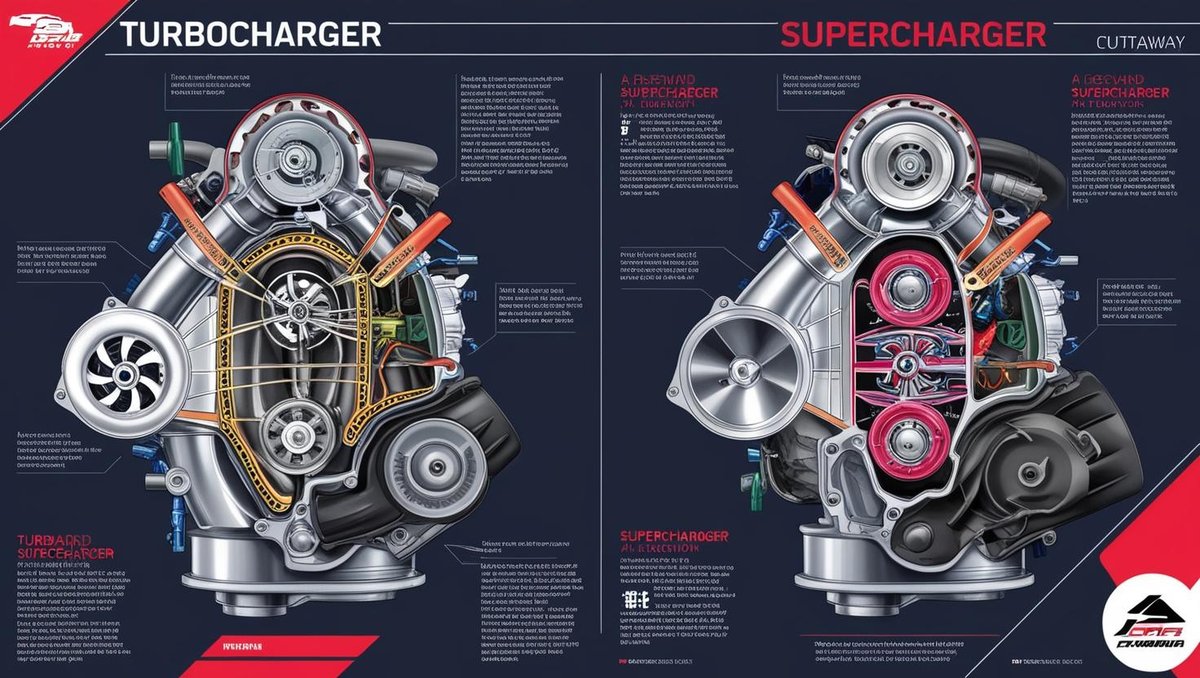
A turbocharger uses exhaust gases to spin a turbine, which compresses incoming air and forces it into the engine's cylinders. This allows the engine to burn more fuel per cycle, producing significantly more power without increasing displacement. The key components are the turbine housing, compressor wheel, and wastegate, which regulates boost pressure. In simple terms: exhaust flows out → spins turbine → spins compressor → forces more air in → more power.
In real driving, turbochargers exhibit a characteristic called "turbo lag"--a delay between pressing the throttle and feeling the surge of power. Modern twin-scroll turbos and variable geometry turbos have reduced lag to under 0.5 seconds in many applications, but it's still present. For example, the 2026 Mazda CX-90's 3.3L turbo inline-6 delivers peak torque at just 2,000 rpm, making lag nearly imperceptible. However, larger turbos on high-performance cars like the Porsche 911 Turbo S still have a noticeable delay before the boost hits.
Throttle response is linear once the turbo spools, but the initial tip-in can feel lazy compared to naturally aspirated engines. Turbocharged engines also generate more heat, requiring intercoolers and robust cooling systems. On the plus side, they offer excellent fuel economy during light throttle because the engine can operate at lower displacement effectively. The EPA estimates that turbocharged engines improve fuel efficiency by 15-25% compared to naturally aspirated engines of equivalent power.
2. Supercharger: Instant Throttle Response with a Mechanical Cost
Superchargers are mechanically driven by the engine's crankshaft via a belt, gear, or chain. Unlike turbos, they don't rely on exhaust flow, so there is zero lag. The most common types are Roots (positive displacement), twin-screw, and centrifugal. Roots superchargers sit on top of the engine and force air directly into the intake manifold, creating that iconic whine. Centrifugal superchargers resemble turbos but are belt-driven, offering more linear boost as RPM rises.
In real driving, a supercharged engine feels immediate and aggressive. The moment you touch the throttle, boost is available. This makes superchargers ideal for stop-and-go traffic, autocross, or any situation where instant response matters. The downside is parasitic loss--the supercharger saps 10-20% of the engine's power just to spin itself. This reduces overall efficiency and hurts fuel economy. For example, the 2026 Ford Mustang Shelby GT500 with its 5.2L supercharged V8 produces 760 hp but gets only 14 mpg combined.
Superchargers also generate significant heat, especially under sustained boost. Heat soak can reduce performance after repeated hard runs. Maintenance is higher than naturally aspirated engines because the supercharger unit itself requires periodic oil changes and belt replacements. Over 100,000 miles, expect to spend $1,500-$3,000 on supercharger-specific maintenance, including rebuilds or replacements on some units.
3. Naturally Aspirated: The Purist's Choice for Linearity and Reliability
Naturally aspirated (NA) engines rely solely on atmospheric pressure to draw air into the cylinders. No forced induction, no complex plumbing. The result is a power curve that builds smoothly and predictably from idle to redline. Throttle response is instantaneous because there's no lag or parasitic loss--every millimeter of pedal travel translates directly to air and fuel delivery. This makes NA engines the gold standard for driver engagement, especially in sports cars like the Porsche 911 GT3 or Mazda MX-5 Miata.
In real driving, NA engines feel linear and progressive. You have to rev them to get peak power, which rewards enthusiastic driving. The downside is that they produce less torque at low RPM compared to forced-induction engines. A 2.0L NA engine might make 150 lb-ft of torque at 4,000 rpm, while a 2.0L turbo can make 250 lb-ft at 2,000 rpm. This means NA cars often feel slower in everyday driving unless you downshift and rev them out.
Reliability is the NA engine's strongest suit. With fewer moving parts, no turbocharger bearings, no intercooler plumbing, and no supercharger drive system, there's less to break. According to data from Consumer Reports, naturally aspirated engines have a 32% lower rate of major repairs over 100,000 miles compared to turbocharged engines. Oil change intervals are typically longer, and there's no risk of turbo failure or boost leaks. However, NA engines generally achieve lower fuel economy than equivalent turbo engines because they can't downsize displacement effectively.
4. Reliability and Maintenance Costs Over 100,000 Miles
When comparing long-term costs, naturally aspirated engines are the clear winner. A typical NA engine will cost about $3,500-$5,000 in maintenance over 100,000 miles, including oil changes, spark plugs, belts, and coolant flushes. Turbocharged engines add $1,500-$3,000 for turbo-specific issues like wastegate failure, oil line clogs, and intercooler leaks. Supercharged engines are the most expensive, with $2,000-$4,000 in additional costs for supercharger rebuilds, belt replacements, and heat-related component failures.
Turbochargers are particularly vulnerable to oil quality. Using the wrong oil or extending oil change intervals can cause coking (carbon buildup) on the turbo bearings, leading to failure. Many manufacturers now recommend 5,000-mile oil change intervals for turbo engines. Superchargers, especially Roots-type, can suffer from rotor wear and seal leaks after 60,000 miles. Centrifugal superchargers are more reliable but still require periodic gearbox oil changes.
Naturally aspirated engines have fewer failure points. The most common issues are carbon buildup on direct-injection engines (which affects all types) and valve train wear. However, these are generally less expensive to fix than turbo or supercharger repairs. For example, replacing a turbocharger on a 2020 Ford F-150 EcoBoost costs $2,500-$3,500, while replacing a supercharger on a 2019 Chevrolet Camaro ZL1 costs $4,000-$6,000. A naturally aspirated engine's major repair, like a timing chain replacement, typically runs $1,500-$2,500.
5. Best Cars for Each Engine Type at $30K, $50K, and $80K
At $30,000: For turbocharged, the 2026 Mazda CX-30 2.5T ($31,500) offers 250 hp and 320 lb-ft of torque with minimal lag. For supercharged, options are limited at this price, but the 2026 Ford Mustang EcoBoost High Performance ($33,000) uses a turbo, not supercharger. The best naturally aspirated choice is the 2026 Mazda MX-5 Miata ($29,500) with its 2.0L NA engine producing 181 hp and a 6,800 rpm redline. It's the purest driving experience under $30K.
At $50,000: Turbocharged: 2026 BMW M240i xDrive ($49,500) with a 3.0L twin-turbo inline-6 making 382 hp. Supercharged: 2026 Ford Mustang GT Premium ($48,000) is naturally aspirated, but the 2026 Chevrolet Camaro LT1 ($47,000) offers a 6.2L NA V8. For a supercharged option, the 2026 Dodge Challenger R/T Scat Pack Widebody ($52,000) uses a 6.4L NA V8--no supercharger at this price. The best supercharged car near $50K is the 2026 Jaguar F-Type P450 ($54,000) with a supercharged 5.0L V8 producing 444 hp.
At $80,000: Turbocharged: 2026 Porsche 911 Carrera ($78,000) with a twin-turbo 3.0L flat-6 making 379 hp. Supercharged: 2026 Chevrolet Corvette Z06 ($82,000) is naturally aspirated with a 5.5L V8, but the 2026 Dodge Challenger SRT Hellcat Redeye ($80,000) uses a supercharged 6.2L V8 producing 797 hp. Naturally aspirated: 2026 Porsche 718 Cayman GT4 ($79,000) with a 4.0L flat-6 producing 414 hp and a 8,000 rpm redline--the ultimate NA experience.
Your choice ultimately depends on whether you prioritize instant response (supercharger), efficiency with punch (turbocharger), or linearity and reliability (naturally aspirated). Test drive all three back-to-back to feel the difference in throttle response and power delivery. The right engine transforms a car from transportation to an extension of your driving personality.