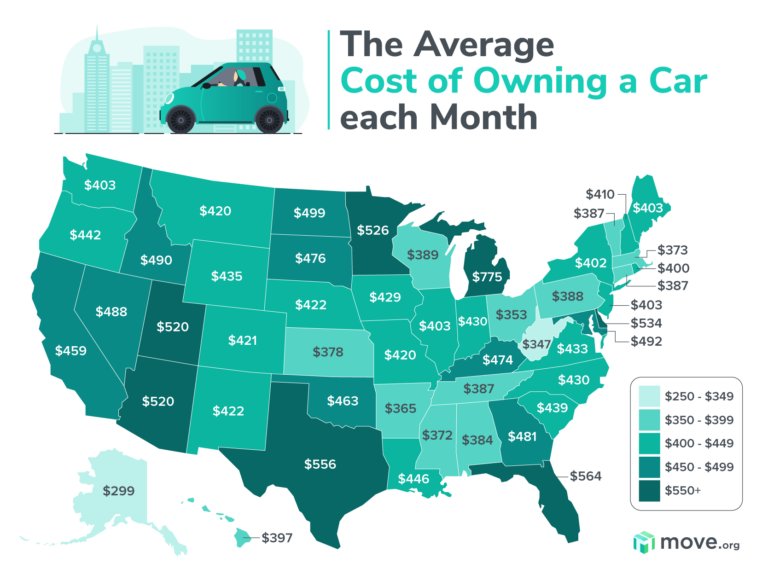
When you buy a car, the sticker price is just the beginning. Most Americans focus on the monthly payment and forget the thousands of dollars in hidden costs that pile up every single year. From the moment you drive off the lot, your car starts losing value, demanding insurance, requiring maintenance, and consuming fuel or electricity. According to AAA, the average annual cost to own and operate a new vehicle in 2025 hit $12,297 -- that's over $1,024 per month. Yet many drivers budget only for the loan payment and gas. This article exposes the four biggest hidden costs of car ownership that Americans routinely underestimate, with real data and actionable advice to help you save thousands.
Key Stat: Depreciation alone costs the average new car owner $4,538 per year over the first five years -- more than any other single expense, according to Edmunds data.
1. Depreciation: The Silent Wealth Drain You Can't Ignore
Depreciation is the single largest cost of car ownership, yet it's invisible because you don't write a check for it. The moment you take delivery, your car's value drops by 10-15% just driving off the lot. Over the first five years, most vehicles lose 40-60% of their original value. For a $40,000 sedan, that's $16,000 to $24,000 in lost value -- or $3,200 to $4,800 per year. Luxury cars and electric vehicles often depreciate even faster. A BMW 5 Series loses about 60% after five years, while a Tesla Model 3 retains roughly 50% depending on mileage and condition.
Why do Americans underestimate depreciation? Because it's not a monthly bill. But if you trade in or sell your car after a few years, the gap between what you owe and what you get is a real cash loss. The best way to minimize depreciation is to buy a vehicle with strong resale value. Models like the Toyota Tacoma, Honda Civic, and Subaru Outlaw typically retain 50-60% of their value after five years. Alternatively, buying a 2-3 year old used car lets someone else absorb the steepest depreciation curve. According to iSeeCars, a three-year-old car has already lost about 30% of its value, saving you thousands compared to buying new.
2. Insurance, Registration, and Taxes: The Annual Tax You Can't Escape
Insurance premiums vary wildly by state, age, driving record, and vehicle type. The average annual full-coverage insurance cost in the US is $2,014, according to Bankrate. But that's just the national average. In Michigan, drivers pay an average of $3,288 per year, while in Maine it's only $1,128. Young drivers under 25 can pay double or triple that. Registration fees also differ dramatically. California charges $200-$300 annually based on vehicle value, while Alabama charges a flat $23. Property taxes on vehicles exist in 28 states, with Virginia and Missouri being among the highest -- up to 4% of the car's assessed value each year.
For a $35,000 car in a high-cost state like Michigan, you could easily spend $3,500 on insurance, $250 on registration, and $1,400 on property tax -- totaling over $5,000 per year before you even drive a mile. Many buyers forget to factor in these recurring costs when choosing a vehicle. To reduce these expenses, shop for insurance annually, consider raising your deductible to $1,000, and check if your state offers discounts for low-mileage or electric vehicles. Also, avoid luxury cars if you live in a state with high property taxes -- a $50,000 BMW could cost you $2,000 in taxes alone each year.
3. Maintenance and Repair Costs: The Budget Buster That Sneaks Up
Routine maintenance -- oil changes, tire rotations, brake pads, and fluid flushes -- adds up faster than most drivers expect. AAA estimates the average annual maintenance cost for a new car at $1,186 per year. But this varies significantly by model. A Toyota Corolla costs about $400 per year in maintenance, while a BMW 3 Series can run $1,200 annually. Over five years, that's a $4,000 difference. Repair costs are even more unpredictable. A transmission replacement can cost $3,000-$5,000, and a new engine can run $4,000-$8,000. Even a simple alternator replacement averages $500-$700.
To avoid surprise bills, follow the manufacturer's maintenance schedule religiously. Skipping a $100 oil change can lead to a $5,000 engine repair. Also, consider buying an extended warranty or a certified pre-owned vehicle with a factory-backed warranty. For used cars, set aside $50-$100 per month in a dedicated repair fund. According to RepairPal, the most reliable brands -- Toyota, Honda, and Mazda -- average $400-$600 in annual maintenance, while luxury brands like Audi, BMW, and Mercedes-Benz average $1,000-$1,500. Choosing a reliable, easy-to-repair vehicle is one of the smartest financial decisions you can make.
4. Fuel and Electricity Costs: Gas vs Hybrid vs EV -- The 5-Year Comparison
Fuel is the most visible recurring cost, but its true impact is often underestimated. At $3.50 per gallon and 15,000 miles per year, a gas car getting 25 mpg costs $2,100 annually. Over five years, that's $10,500. A hybrid like the Toyota Camry Hybrid at 50 mpg cuts that to $1,050 per year -- saving $5,250 over five years. An electric vehicle like the Tesla Model 3, at 28 kWh per 100 miles and $0.14 per kWh, costs about $588 per year in electricity -- saving $7,560 over five years compared to the gas car. But EV owners must also factor in home charging installation ($500-$2,000) and potential public charging costs, which can be 2-3 times higher per mile.
The gap widens with gas prices. If gas hits $5 per gallon, the gas car's annual cost jumps to $3,000, while the EV stays at $588. However, EVs have higher upfront costs -- the average EV costs $55,000 vs $35,000 for a gas car. After factoring in federal tax credits (up to $7,500) and state incentives, the total cost of ownership can favor EVs, especially in states with high gas prices and low electricity rates. For example, in California, an EV saves $1,500 per year in fuel alone. But in states with cheap gas and expensive electricity, like Hawaii, the savings shrink. Always calculate your specific fuel or electricity cost using the EPA's fueleconomy.gov tool before buying.
By understanding these four hidden costs -- depreciation, insurance/taxes, maintenance, and fuel -- you can make a smarter purchase decision and save thousands over the life of your vehicle. The cheapest car to buy is rarely the cheapest to own. Do your homework, choose a reliable model with low depreciation, and budget for all expenses, not just the monthly payment.